| | 13 May, 2008
| | How embryonic stem cells develop into tissue-specific cells demonstrated by Hebrew University, other researchers | |
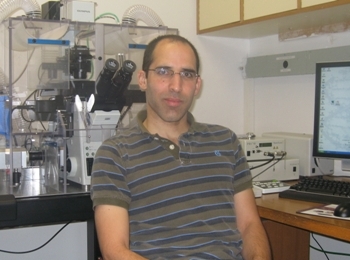 | | Dr. Eran Meshorer |
|
While it has long been known that embryonic stem cells have the ability to develop into any kind of tissue-specific cells, the exact mechanism as to how this occurs has heretofore not been demonstrated. Now, researchers at the Hebrew University of Jerusalem and elsewhere have succeeded in graphically revealing this process, resolving a long-standing question as to whether the stem cells achieve their development through selective activation or selective repression of genes.
The collaborative research group, which included Dr. Eran Meshorer of the Department of Genetics at the Silberman Institute of Life Sciences at the Hebrew University of Jerusalem, has revealed that the embryonic stem (ES) cells express large proportions of their genome “promiscuously.” This permissive expression includes lineage-specific and tissue-specific genes, non-coding regions of the genome that are normally “silent,” and repetitive sequences in the genome, which comprise the majority of the mammalian genome but are also normally not expressed.
When ES cells differentiate into specific cell tissue-types, they undergo global genetic silencing. But until this occurs, the ES cells maintain an open and active genome. This might very well be the secret of their success, since by maintaining this flexibility they maintain their capacity to become any cell type. Once silencing, or genetic repression, occurs, this ability is gone.
Thus, one can say that the ES cells stand at the ready until the “last minute” -- prepared to engage in selective activation into specific cells -- holding “in abeyance” their ability to become any kind of cells at the point and time required.
To reveal the process as to how this occurs, the researchers created the first full-mouse genomic platform of DNA microarrays. Microarrays are glass-based chips that allow simultaneous detection of thousands of genes. The microarrays used in the study were not confined to specific genes only but spanned the entire genome.
Hundreds of such microarrays were required in the study to cover the entire genome in different time points during stem cell differentiation. It was by observation of these sequences that the researchers were able to establish exactly how and at what point the stem cells developed into specific tissue cells and when the silencing occurs.
The project carried out by the researchers appears in the latest issue of the journal Cell Stem Cell. The collaborators in addition to Dr. Meshorer who participated in the project include Tom Misteli, Ron McKay, Stuart Le Grice, Sol Efroni and Kenneth Buetow of the US National Institutes of Health, Thomas Gingeras of Affymetrix Inc. of Santa Clara, Calif., and David Bazett-Jones of The Hospital for Sick Children, Toronto.
|
Downloadable File: stemcells.doc |
|