| | 06 June, 2007
| | Miniature robot for precise positioning and targeting in keyhole neurosurgery wins Kaye Award for Hebrew University researcher | |
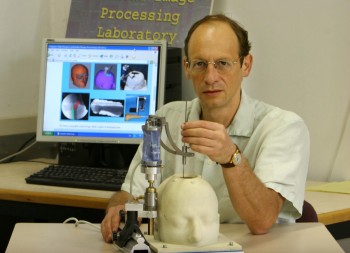 | | Prof. Leo Joskowicz (Photo: Sasson Tiram) |
|
While recent advances in neurosurgery have made it possible to precisely target areas in the brain with minimum invasiveness -- using a small hole to insert a probe, needle or catheter -- there remains a disadvantage. The small size of the openings reduces or eliminates direct site visibility and requires greater dexterity, stability and precision by the surgeon.
Now, an invention by a Hebrew University of Jerusalem researcher has made it possible to retain the advances of such keyhole surgery through utilization of the “services” of a tiny robot that can guide surgical procedures with great accuracy. For this development, Prof. Leo Joskowicz of the School of Engineering and Computer Science at the Hebrew University has been named one of this year’s winners of a Kaye Innovation Award, to be presented on June 6 during the Hebrew University’s 70th Board of Governors meeting. Prof. Joskowicz is the founder of the Computer-Aided Surgery and Medical Image Processing Laboratory at the Hebrew University, which he heads to this day.
Although keyhole brain surgery, based on preoperative CT or MRI images, has obvious advantages for the patient, misplacement of the surgical instrument in these procedures may result in hemorrhage and severe neurological complications.
To overcome this problem, Prof. Joskowicz and his associates have developed a novel, image-guided system for precise, automatic targeting of structures inside the brain. The system is based on a miniature robot that can be programmed with detailed information obtained from preoperative electronic scans of the patient.
During surgery, the robot is directly affixed to a head clamp or to the patient's skull. It automatically positions itself with great accuracy in respect to the surgical targets. Once positioned, the robot locks itself in place and serves as a guide for insertion by the surgeon of a needle, probe, or catheter to carry out the procedure.
The main advantages of the system are the reduced pain for the patient, its compactness and ease of use, and its applicability to a wide variety of neurosurgical procedures.
The system was developed jointly by Prof. Joskowicz with Ph.D. students Ruby Shamir and Moti Freiman of the School of Engineering and Computer Science at the Hebrew University; Prof. Moshe Shoham of the Department of Mechanical Engineering at the Technion-Israel Institute of Technology; Dr. Yigal Shoshan and Prof. Felix Umansky, of the Department of Neurosurgery at Hadassah Hebrew University Medical Center.
The two-year project was funded by a grant from the Israel Ministry of Trade and Industry through Yissum, the technology transfer company of the Hebrew University, which has commercialized it for product development by Mazor Surgical Technologies, Israel.
The Kaye Innovation Awards at the Hebrew University have been awarded annually since 1994. Isaac Kaye of England, a prominent industrialist in the pharmaceutical industry, established the awards to encourage faculty, staff, and students of the University to develop innovative methods and inventions with good commercial potential which have benefited or will benefit the University and society.
|
Downloadable File: Joskowicz.doc |
|